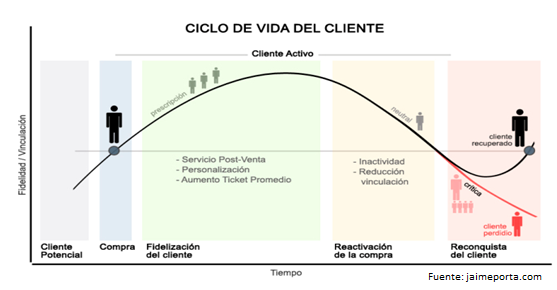
 Understanding the customer lifecycle is fundamental for product design and customer management (CRM). It helps optimize engagement and, consequently, increase revenue and product sustainability. Plenty of information exists online about the lifecycle and its importance in business and marketing. However, there is almost no information or references about how to measure the customer lifecycle. The little information out there is scarce, theoretical and subjective. Measuring the customer lifecycle reveals the best time to send a promotion. It also shows how much time a customer needs to understand your product. This article aims to provide an objective and practical way to model and calculate the customer lifecycle This helps define and set up marketing and product strategies with better criteria.
Customer lifecycle basics
Although the concept of “life cycle” seems trivial and well known, many related concepts create confusion.
First of all, we should differentiate between customer lifecycle and customer lifetime value (known as LTV). The last one defines a monetary “value” expressed by a mathematical formula. Meanwhile, the customer life cycle describes the phases and stages that the customer passes through interacting with the product We usually express it as a chart or state diagram.
Another commonly confused term is the costumer journey It is a “lean” tool to develop the user experience of the product. The lifecycle explains how customers interact with the product. The customer journey is a design tool that allows us to improve engagement by understanding the life cycle.
The need to model and measure the customer lifecycle
The managment team must understand the customer lifecycle. However, this is not enough nowadays where technologies allows us to measure absolutely everything. Most organizations know their customer lifecycle. However, they approach it theoretically, based on past experiences and intuitions.
The main advantage to model and measure the customer lifecycle allows us to respond objectively to product management questions. Otherwise, these would be answered based on management intuition. Some example questions could be when to send an informational email to customers or when to create a sales promotion.
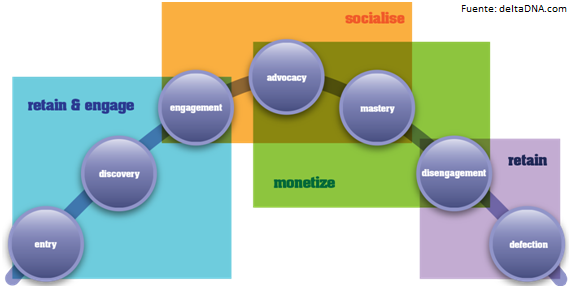
Lets suppose that we have modeled and constructed the previous lifecycle graph from our customers. Through this graph, we can establish strategies for each stage:
- For the phases of entry, discovery and engagement we could apply retention and engagement strategies. These include welcome messages, tips, and tutorials.
- For the stages of engagement, advocacy and mastery, the customer reaches peak engagement. Here we apply socialization and monetization strategies. Tactics include first conversion messages, loyalty programs, and VIP strategies.
- For the states of disengagement and deflection we apply strong retention tactics such as promotions, gifts, new content, special events, etc.
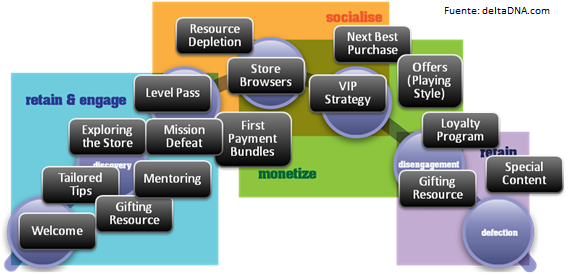
The previous graph shows the customer lifecycle with different strategies and tactics for each phase. However, at what exact moment we should apply each tactic? This is where most of the organizations get stuck because they do not objectively model and calculate their customer lifecycle.
Model the customer lifecycle
Representing the amount of use or engagement for a customer cohort produces a representative graph of the customer lifecycle.
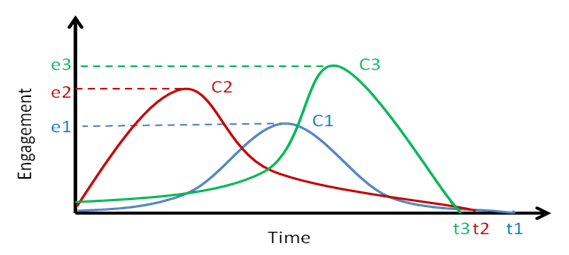
The previous graph shows the lifecycles from three different customers (or group of customers C1, C2 and C3). The abscissa represents the customer lifetime from beginning to end. The ordinates axis represents the amount of engagement for each customer. Engagement uses metrics that the product team feels more confortable or believes its more appropiate to the product itself (number of sessions per day, average session time, number of events or actions, or even sales). The important thing is that ordinate represents the use of the product in a comparative way.
Understanding Engagement Curves
The values t1, t2 and t3 represent the cutoff points with zero engagement, In other words, they indicate the total lifetime of each customer. This data feeds into the LTV calculation. In contrast, the slopes of the curves and their distribution types (normal, binomial, right or left-skewed, etc.) indicate the engagement level for each t-value.
From these graphs, we can identify key points like the “aha moments”, moments of maximum engagement and moments of boredom or decline. Understanding these graphs objectively helps us establish strategies to enhance those moments. For example, at the initial customer stages we can focus the product and customer management efforts on learning and onboarding, in the phase of maximum engagement we can focus on retention and conversion and in the decline phase on reactivation and cross promoting or cross selling other products. These graphs help us define strategies. They also measure how the product evolves.
Measure the customer lifecycle
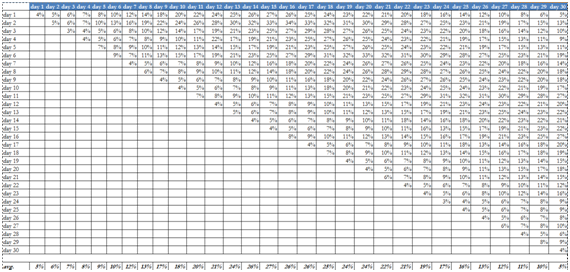
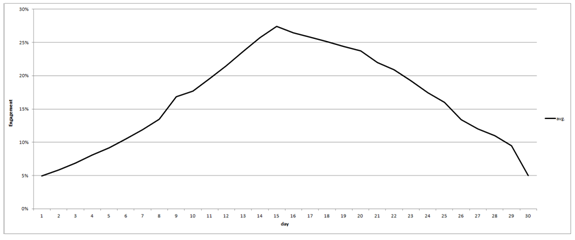
Now that we understand the model and its objective, we can obtain the data for the graph. We make the calculation through engagement cohorts (or the product use data chosen). After completing the calculations, we represent the cohort data through graphs. The resulting model is the customer lifecycle representation from the previous section. This time, it includes actual numbers.
Practical Application of the Model
Using the chart above, we could make the following management and product assumptions:
- From day 1 to 8 do nothing, since the evolution is of product learning.
- From day 8 start with monetization stategies because the customer already knows the product and begins to use it more often.
- Day 15 is the key moment where the customer starts to lose interest. At that time we could unlock additional features or make some special event accompanied by a communication.
- From day 20 or 21 the strategy would be focused on keeping the customer or trying to cross it to another product.
- On the 28th, we might have lost the customer.
If we perform aggressive strategies on certain days and re-calculate the chart, we can see how effective those changes are. For example, we can check if those changes encouraged the customer to stay beyond day 28. The goal of the product and customer management team is to achieve the highest engagement point (e max ) in the shortest time possible and sustain it over time.
I hope this article gave you a better insight into the customer lifecycle. Understanding its uses across business areas is essential. Now you can put into practice the monitoring of strategies through modeling and measuring the customer lifecycle.